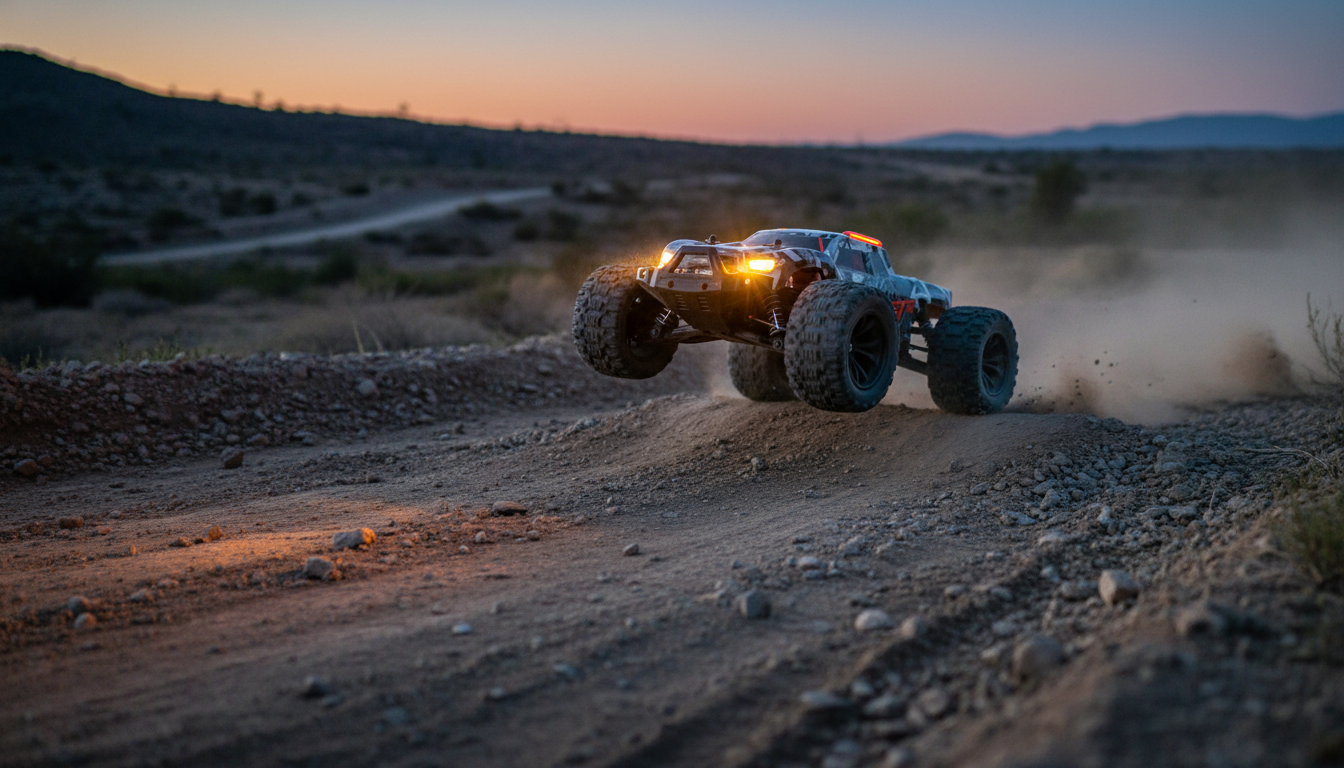
A 4WD RC off-road truck built for fast runs on dirt, gravel, and short grass feels very different from a basic backyard toy: it launches harder, holds traction through turns, and stays visible when the light drops thanks to built-in LEDs. This guide breaks down what matters most—drivetrain, speed control, handling, durability, battery habits, and practical tips—so the truck performs well from the first run and keeps running after the bumps and rollovers that come with off-road racing.
What this truck is designed to do
- 4WD traction for loose surfaces: Better pull out of corners and less wheelspin on gravel and packed dirt compared with 2WD.
- High-speed running with off-road control: Tuned for quick acceleration while still absorbing uneven terrain with suspension and knobby tires.
- LED lights for visibility and style: Helps track direction at dusk, under trees, or in shaded areas where an RC can disappear quickly.
- All-around versatility: A strong choice for driveways, parks, and hard-packed trails—great for speed runs, quick races, and learning controlled slides.
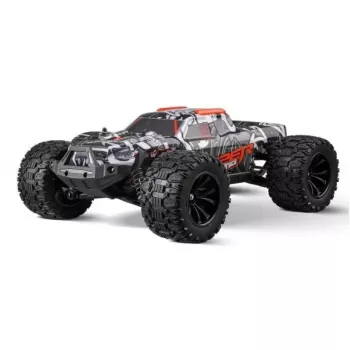
If you’re ready to run a 4WD basher that stays easy to spot, start with the RC Off-Road Truck 4WD High-Speed Racing with Lights.
Key features that affect real-world performance
- 4WD system: Distributes power to all wheels for improved climbing, braking stability, and corner-exit grip on loose ground.
- Chassis stance and ground clearance: Higher clearance helps avoid getting hung up on small rocks and ruts, while a wider stance improves stability at speed.
- Suspension travel and damping: Longer travel soaks up bumps; stiffer damping reduces bounce when landing small jumps or crossing rough patches.
- Tires and tread: Deeper, wider tread increases traction on dirt; firmer rubber tends to last longer on asphalt but can reduce grip off-road.
- Steering response: Precise steering trim and a stable servo saver help keep the truck tracking straight during high-speed runs.
- Lights placement: Forward-facing LEDs improve orientation; side/rear glow helps distinguish front vs. back when the truck is far away.
Quick specs checklist before the first run
Five minutes of setup prevents most early issues (random cutouts, poor tracking, unexpected rollovers):
Pre-run checklist
| Item |
What to look for |
Why it matters |
| Wheels/tires |
No wobble, tread intact, nuts snug |
Prevents vibration and loss of control at speed |
| Suspension |
Arms move smoothly, shocks not leaking |
Improves stability over bumps and landings |
| Steering |
Tracks straight, no binding at full turn |
Reduces spinouts and protects servo/gears |
| Battery compartment |
Secure fit, clean contacts |
Avoids cutouts and intermittent power |
| Lights |
All LEDs working |
Maintains orientation in low light |
How 4WD changes handling on dirt, gravel, and grass
Using the lights effectively for racing and night runs
Battery habits that protect speed and runtime
- Charge with care: Charge on a non-flammable surface and avoid leaving batteries unattended while charging. The NFPA’s lithium-ion safety overview is a smart baseline for home charging practices: Battery Safety — Lithium-Ion Batteries.
- Cooldown between runs: Let the motor and battery cool between back-to-back sessions; heat can reduce punch and shorten component life.
- Stop when power drops: When acceleration noticeably fades, bring it in. Over-discharging can cause swelling (Li-ion/LiPo) or reduce long-term capacity (NiMH).
- Keep contacts clean: Oxidation increases resistance and can cause intermittent cutouts during hard launches.
- Storage matters: Store packs partially charged when recommended by the battery type, and keep them in a cool, dry place.
Durability and maintenance for off-road use
For consistent radio control, stick with compliant equipment and avoid improvised electronics changes. The FCC’s overview of authorization and radio-device compliance is a solid reference point: FCC — Equipment Authorization.
Beginner-friendly driving tips for high-speed control
Choosing the right scale for off-road fun
Scale selection at a glance
| Scale (example) |
Best surfaces |
Trade-offs |
| Small (e.g., 1/18–1/16) |
Hard-packed dirt, smooth gravel, driveways |
Less capable in tall grass and deep ruts |
| Mid (e.g., 1/12–1/10) |
Mixed terrain, light trails, small jumps |
Needs a bit more storage and running space |
| Large (e.g., 1/8) |
Rough trails, higher-speed stability, bigger jumps |
Higher impact energy; requires more space |
Helpful add-ons for hauling and pit setup
FAQ
Are RC off-road cars waterproof?
Many are water-resistant rather than truly waterproof: the receiver box, ESC, or servo may be sealed, but bearings, motors, and connectors still dislike prolonged water exposure. Wet grass is usually fine if the electronics are rated for it, but avoid deep puddles, then dry the truck thoroughly and re-lube moving parts to prevent rust.
What scale of RC car is best for off-road?
For mixed terrain and easy control, mid-size (often 1/12–1/10) is a practical sweet spot because it rolls over bumps better than small scales without needing the space of 1/8. If you drive mostly on hard-pack with minimal grass, 1/18–1/16 can be fun and portable; for rough trails and stability at speed, 1/8 is more capable but hits harder and needs more room.
Recommended for you






Leave a comment